Article
May 7, 2026
How airflow modelling in cleanroom design improves performance
A system-level view of airflow gives a stronger basis for balancing compliance, performance, and energy use in pharma manufacturing sites.

Contact our expert
Jens Chr. Bennetsen
Head of Center of Excellence
Cleanrooms are designed to control the things we cannot see.
Airflow, particles, pressure differences. All of it is carefully defined, calculated, and documented. And most of the time, it works as intended. But the real test is not operating in steady conditions. It is when something changes. When a door opens. When pressure changes. When people and materials move through the facility.
That is where performance is tested. And that is where many pharma facilities behave differently than expected.
Why pharmaceutical cleanroom design needs a system-level airflow view
Cleanrooms are often designed one room at a time. On paper, that approach works. Each space meets its requirements. Airflow is controlled. Pressure cascades are defined.
In practice, however, everything is connected. Air moves between rooms and corridors. Pressure differences interact. And small changes in one part of the facility affect conditions elsewhere.
“We still tend to design cleanrooms as isolated spaces, even though they operate as systems,” says Jens Chr. Bennetsen, Head of Center of Excellence, Advanced Simulations.
He points to a gap between design and operation. And we only test the design for a few operational conditions.
“In many cases, facilities are built first and then fine-tuned during commissioning. That can prolong startup, increase work, and lead to systems that are not operating efficiently nor being flexible."
Head of Centre of Excellence, Advanced Simulations
How airflow patterns affect contamination control
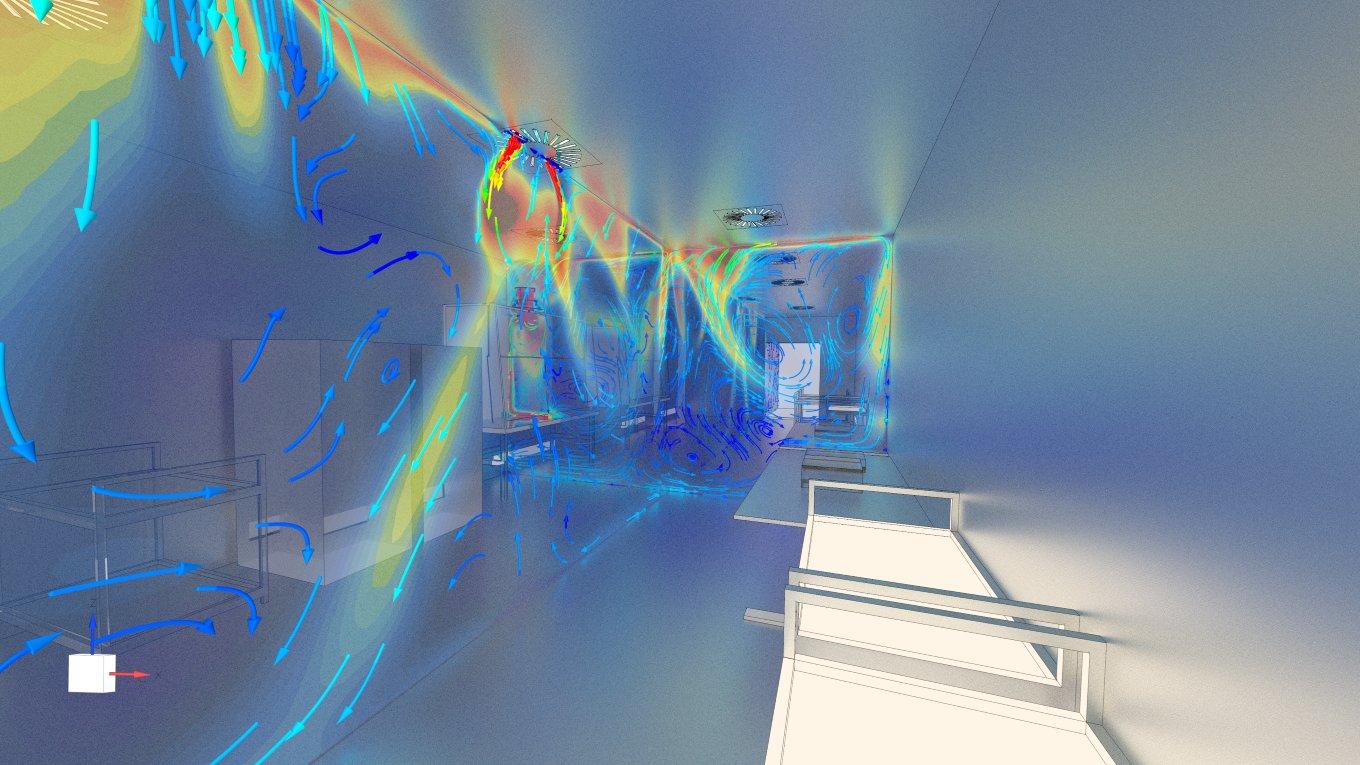
In the Cellerator project at the Technical University of Denmark (DTU), Ramboll used system-level Computational Fluid Dynamics (CFD) to model how a full cleanroom setup behaves in operation. Not just under steady conditions, but during the transitions that define real use. This is where traditional approaches almost always fall short.
Jens Christian Bennetsen says: “When you open a door between two rooms, they suddenly become connected. Air particles, and even the movement of people start to influence what is transferred from one space to another.”
People passing through a doorway do not just move between two rooms. They change the airflow.
Jens Christian adds: “There is a wake behind the person, and that can carry particles from one room to another. At the same time, the pressure balance in the system is affected, and the HVAC system has to respond.”
He compares it to a tyre losing air: “It is not just a small leak. It is like removing a part of the tyre. The system needs to react immediately to maintain pressure.”
Why air change rates alone do not guarantee optimal performance
One of the key findings is that performance is not driven by a single parameter. It is shaped by how airflow, pressure, and movement interact across the system.
Increasing air change rates can significantly reduce particle concentration. In the Cellerator study, an increase from 22 to 33 air changes per hour reduced average particle concentration by up to 55 percent.
But more is not always better. “There is a point where increasing airflow does not improve control but still increases energy use. At that point, you are wasting energy. So, instead of adding more air, the question becomes how the air is distributed and controlled,” says Jens Christian.
The simulation revealed that in several cases, airflow levels were simply too high.
“We often see design based on rules of thumb, where air change rates are set very high. But in some cases, that creates too much turbulence. Instead of moving particles, you end up spreading them,” he explains.
By reducing airflow and improving flow direction, it becomes easier to guide particles out of the space instead of mixing them into the air.
How recovery times impact operations
Another important aspect is recovery. How quickly does a cleanroom return to stable conditions after a disturbance?
Here, the results were clear. Instead of waiting several minutes before moving between spaces, the optimised setup reduced recovery time to around one minute.
“In practical terms, that means you can move people and materials much faster through the facility. We are seeing improvements of two to three times compared to typical assumptions,” explains Jens Christian.
That has a direct impact on operations. Less waiting. Faster workflows. Higher efficiency.
Advanced modelling reduces the risk of late changes
A system-level understanding changes when decisions are made. Instead of adjusting airflow, pressure strategy, or layout late in the project, these decisions can be addressed earlier and with greater confidence.
In the Cellerator project, the modelling led to concrete design changes.
“We could see that some diffusers and extraction points were not placed optimally. By adjusting their position and improving coverage, we avoided dead zones and reduced unnecessary recirculation,” says Jens Christian.
The analysis also led to adjustments in airflow rates across different spaces. This kind of insight is difficult to achieve without a system-level view.
Balancing compliance, performance, and energy efficiency
In pharma facilities, airflow is often increased to ensure compliance. That approach works, but it can lead to overdesign.
We see many cases where systems are designed with significantly higher airflow than needed. That leads to higher energy consumption and less efficient operation,” says Jens Christian.
The consequences, however, go beyond energy. Oversized systems affect ducting, fans, and control systems. And if airflow is reduced later, the equipment may operate outside its optimal range.
With better insight early in the design phase, it is possible to avoid this and focus on what actually makes a difference and create a flexible design from early on.
Understanding the system
The work in the Cellerator cleanroom project points to a broader shift in how pharmaceutical cleanroom design is approached. From designing individual components or rooms to understanding the full system. From relying on assumptions to working with documented behaviour. And from adding safety margins to making informed decisions based on evidence.
Jens Christian says: “We are increasingly moving towards a system approach, because we know that solving one problem in isolation often creates another.”
The same applies across industries, but in pharma, the stakes are higher.
He says: “You need to be confident that every part of the system performs as expected. You cannot afford surprises.”
How cleanroom airflow modelling derisks projects
For pharma clients, the value is clear. A better understanding of system behaviour reduces risk. It shortens commissioning and qualification. It also avoids costly rework and ensures the timelines are met for starting operations.
“The most important aspect is the de-risking. We know the design works as intended, and that reduces uncertainty throughout the project,” says Jens Christian.
In some cases, the impact is substantial.
“There are projects where commissioning can take months, with people manually adjusting systems. If you can test and optimise this before construction, you save both time and cost.”
Head of Centre of Excellence, Advanced Simulations
How we validate the accuracy of CFD models
CFD is not new. But the way it is applied matters. At Ramboll, the focus is on combining detailed modelling with real world validation.
“We prioritise accuracy over shortcuts. We know from physical testing that we can get very close to real behaviour if the models are applied correctly,” says Jens Christian.
This includes:
- using the right modelling resolution
- capturing interactions between spaces
- validating results against physical tests
Combined with high-performance computing, it enables analysis at full system scale without delaying projects.
Why this approach is becoming more important
The use of system-level modelling is expected to grow, not only in pharma, but also in other industries where airflow and contamination control are critical.
“We are already seeing increased trust in these methods. As more projects demonstrate that the results match real operation, adoption will accelerate,” says Jens Christian.
At the same time, facilities are becoming more complex. Automation, aseptic environments, and reduced human interaction place higher demands on design.
Jens Christian says: “That only makes it even more important to understand the full system.”
How to get ahead in GMP cleanroom designs
If Jens Christian Bennetsen were to give one piece of advice to anyone designing cleanrooms today, it would be this:
“Get involved with modelling early and challenge the rules of thumb. What worked 20 years ago is not necessarily the best solution today when meeting new design and operational requirement.”
There is a reason for that. Better insight does not only improve design. It changes how decisions are made and ultimately, how facilities perform.
Contact our expert
Head of Center of Excellence
Explore similar insights
Explore more within Life Sciences and Pharma
Discover how Ramboll helps pharma and biopharma organisations develop advanced manufacturing sites that enhance market readiness and shorten time‑to‑market for new therapies.